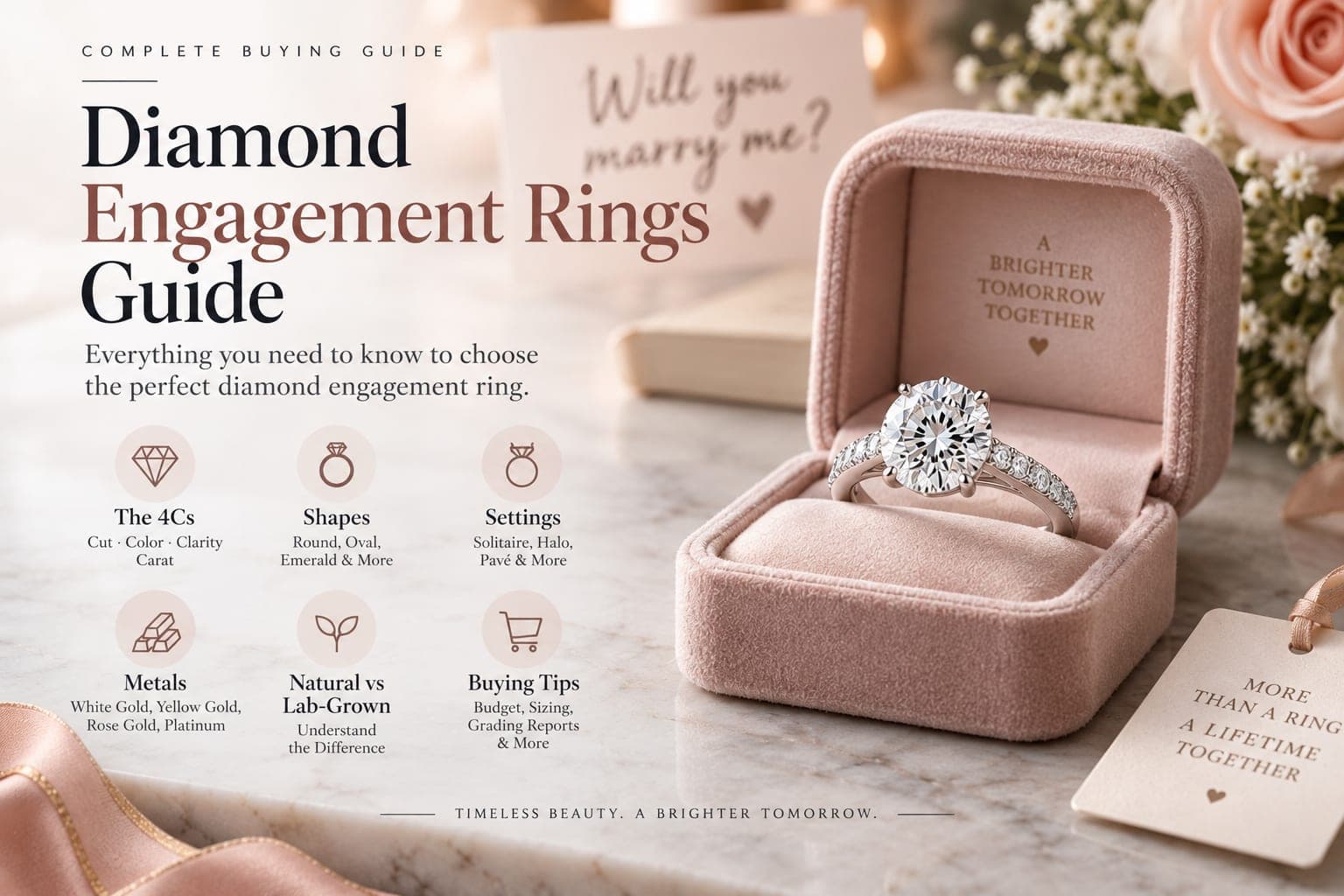
Choosing an engagement ring often starts with one important question: which diamond shape do you like?
Round, oval, emerald, pear, cushion, marquise and other shapes can create dramatically different looks, even when two diamonds have the same carat weight.
The shape affects the outline of the stone, how it interacts with the setting and the overall appearance of the finished ring. It can also influence how large a diamond appears, how much sparkle it produces and how clearly certain characteristics such as color or inclusions may be visible.
This guide explains the most popular engagement ring shapes, what makes each one distinctive and what to consider before choosing one.
What Are Engagement Ring Shapes?
A diamond's shape is its geometric outline when viewed from above.
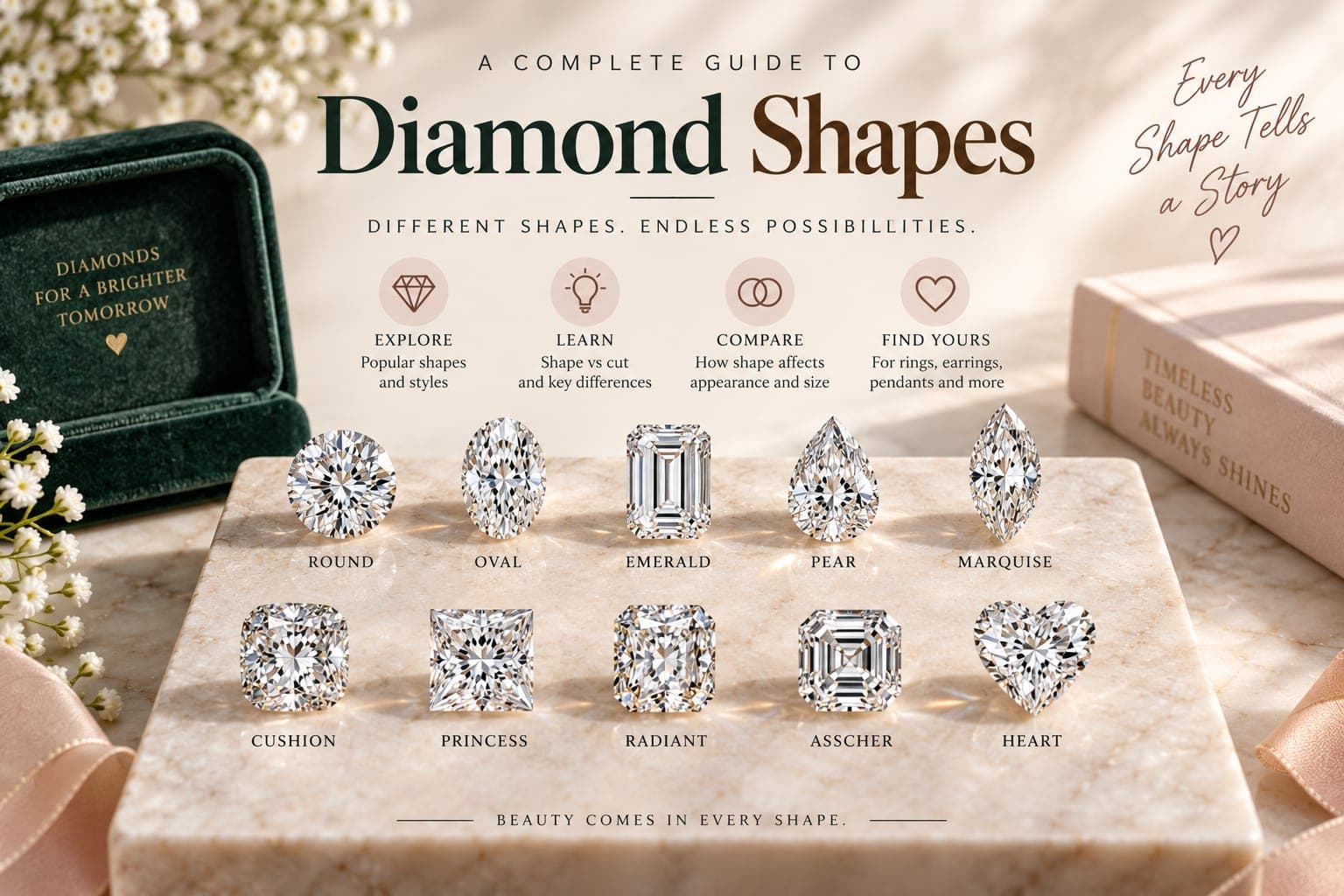
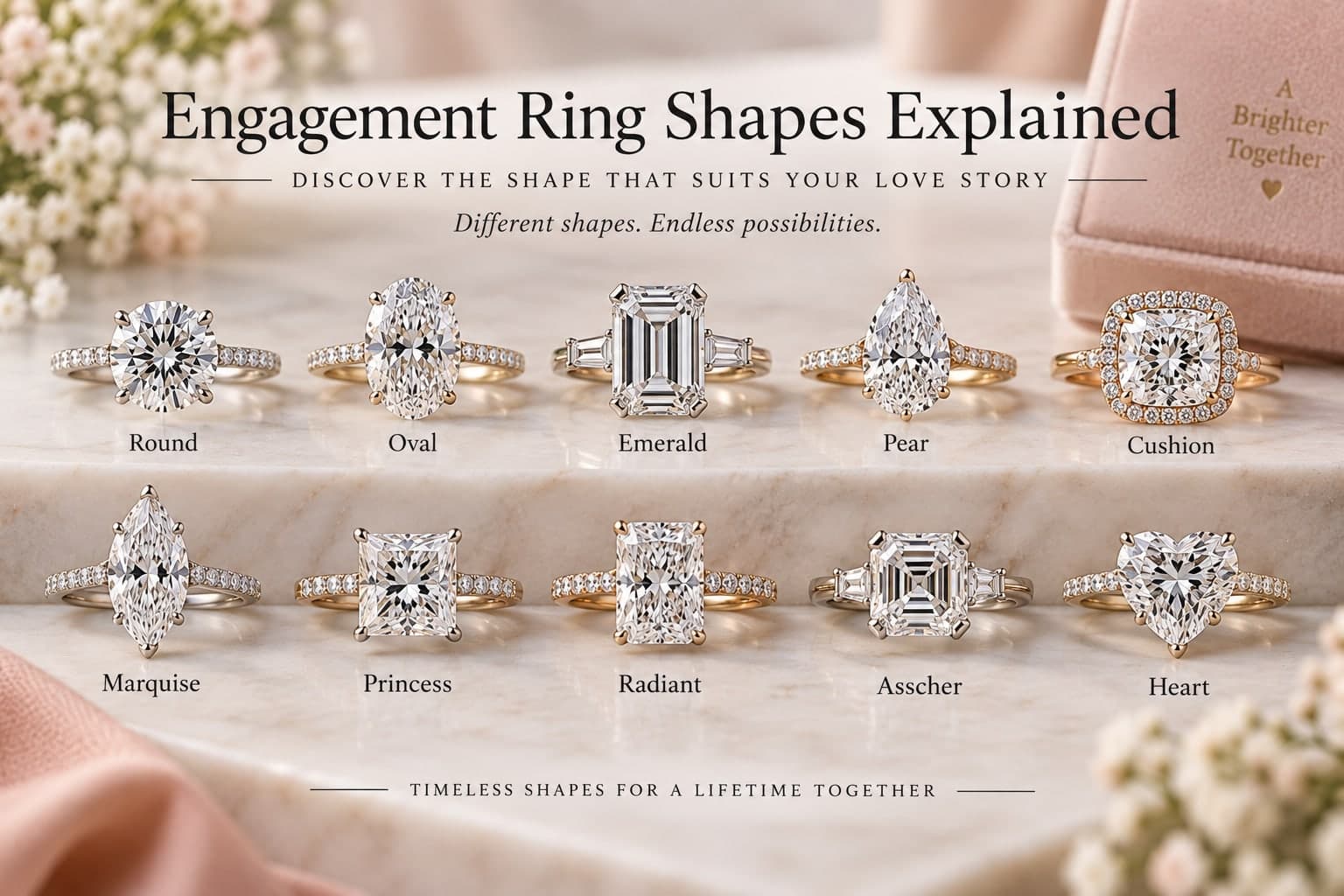
Common diamond shapes include round, oval, pear, marquise, cushion, princess, emerald, radiant, Asscher and heart.
Shape is different from cut.
Cut describes how the diamond's facets are arranged and how effectively the stone interacts with light. A round brilliant, for example, has a specific brilliant faceting pattern, while an emerald cut uses a step-cut pattern with larger, more open facets.
The distinction is important because people often use "cut" and "shape" interchangeably when shopping for engagement rings.
For this guide, we're focusing primarily on shape.
The Most Popular Engagement Ring Shapes
1. Round Engagement Ring
The round brilliant is one of the most recognizable diamond shapes and remains a traditional choice for engagement rings.
Its circular outline and brilliant faceting pattern are designed to return a significant amount of light, giving the stone its characteristic sparkle. GIA notes that the round brilliant is the only standard diamond shape with an official GIA cut grade.
Why choose a round shape?
A round diamond can work with a wide range of engagement ring settings and styles.
It can be paired with:
Solitaire settings
Halo settings
Three-stone designs
Pavé bands
Vintage-inspired settings
Modern minimalist rings
If you want a versatile shape that works across many different designs, round is an easy starting point.
2. Oval Engagement Ring
An oval diamond combines a rounded outline with an elongated silhouette.
Because of its elongated shape, an oval can appear larger face-up than a round diamond of the same carat weight, although the actual appearance depends on the stone's proportions and cut quality.
Oval diamonds can have a graceful and contemporary appearance while still retaining much of the brilliance associated with brilliant-cut diamonds.
One thing to examine when shopping for an oval is the bow-tie effect. This refers to a darker area that can appear across the center of some elongated diamonds. Its visibility varies from stone to stone.
Oval shapes work well with
Solitaire rings
Halo settings
Three-stone rings
Pavé bands
Vintage-inspired designs
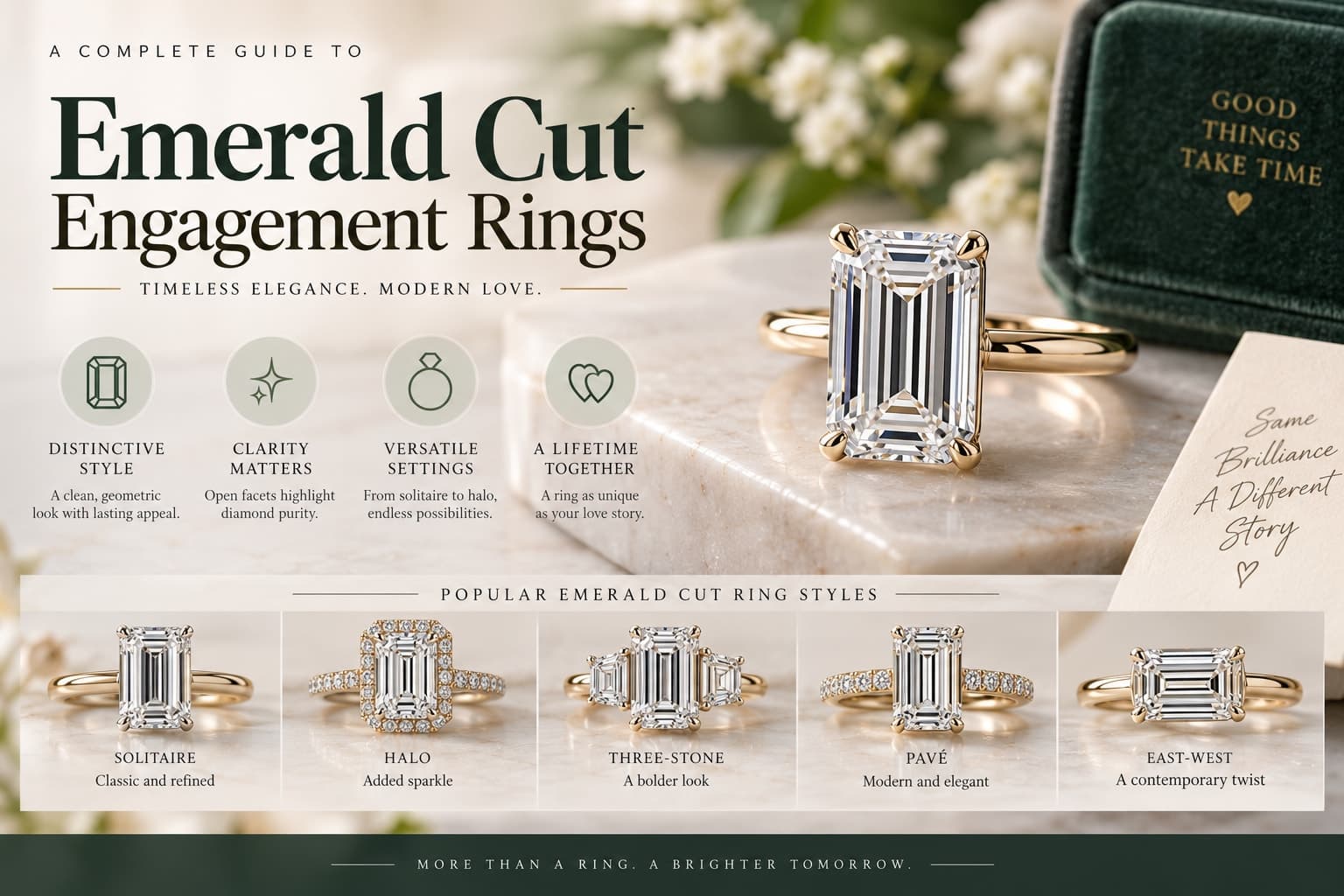
3. Emerald Engagement Ring
The emerald shape has a rectangular outline with cropped corners and a step-cut faceting pattern.
Instead of producing the busy sparkle associated with brilliant cuts, emerald-cut diamonds are known for their larger, elongated facets and reflective appearance. GIA describes this visual effect as a "hall of mirrors."
Because the facets are larger and more open, emerald-cut diamonds can make color and inclusions easier to see than they may be in some brilliant-cut shapes.
This makes clarity and color considerations particularly important when comparing emerald diamonds.
Emerald shapes often suit
Minimalist rings
Art Deco-inspired designs
Modern settings
Vintage-inspired engagement rings
Three-stone designs
Your separate Emerald Cut Engagement Rings article will cover this shape in much greater depth, so we don't need to create another general article targeting the same search intent.
4. Pear-Shaped Engagement Ring
A pear-shaped diamond combines a rounded end with a pointed tip, creating a teardrop-like outline.
It combines characteristics associated with round and marquise shapes while creating a distinctly asymmetric silhouette.
The pointed end means the setting deserves particular attention. GIA notes that secure protection around the tip is important because pointed areas can be more vulnerable to damage.
Pear diamonds can be worn with the point facing toward or away from the hand, depending on the ring design and personal preference.
Pear shapes can work with
Solitaire settings
Halo rings
Three-stone designs
Vintage-inspired rings
Modern engagement rings
5. Cushion Engagement Ring
The cushion shape has a square or rectangular outline with rounded corners.
Its softer edges give it a different appearance from sharper square shapes such as princess diamonds.
Tiffany describes the cushion as a square or rectangular shape with rounded edges, sometimes referred to as a pillow-cut diamond.
Cushion diamonds can have different proportions and faceting patterns, meaning two cushion engagement rings may look quite different from each other.
Cushion shapes work well with
Halo settings
Solitaire rings
Vintage-inspired designs
Three-stone rings
Romantic engagement ring styles
6. Marquise Engagement Ring
The marquise shape is long and narrow with pointed ends.
Its distinctive silhouette gives the diamond a dramatic appearance and can create the impression of a larger face-up stone for its carat weight.
Because both ends are pointed, protection is an important consideration when selecting a marquise engagement ring. GIA notes that V-prongs or similarly secure approaches can help protect the tips.
Marquise diamonds can also be set horizontally for an east-west engagement ring, creating a more contemporary interpretation.
7. Princess Engagement Ring
The princess shape is generally square or rectangular with sharp corners and brilliant-style faceting.
Its clean geometry gives it a distinctly modern appearance.
The corners deserve attention when choosing a setting because pointed corners can be more vulnerable to damage. Protective setting designs can help reduce exposure.
A princess diamond can work particularly well in:
Solitaire rings
Channel settings
Halo designs
Modern engagement rings
Three-stone designs
8. Radiant Engagement Ring
The radiant shape combines a rectangular or square outline with brilliant-style faceting.
It has cropped corners and can therefore offer a geometric outline without the sharp corners found on some square shapes.
GIA describes radiant diamonds as combining the clean lines associated with rectangular shapes with the brilliance of a brilliant-cut faceting pattern.
Radiant diamonds can be square or elongated, giving shoppers some flexibility in the proportions they prefer.
Radiant shapes work well with
Solitaire settings
Halo designs
Three-stone rings
Modern settings
Pavé bands
9. Asscher Engagement Ring
The Asscher shape has a square outline with cropped corners and step-cut facets.
It has a geometric appearance that is often associated with Art Deco-inspired jewelry.
Like emerald-cut diamonds, its larger step facets can make clarity and color more noticeable than they may be in highly faceted brilliant-cut diamonds.
An Asscher engagement ring can be an interesting choice for someone who wants a structured, symmetrical appearance rather than the intense sparkle associated with a round brilliant.
10. Heart-Shaped Engagement Ring
The heart shape is exactly what its name suggests: a symmetrical diamond outline resembling a heart.
It has two rounded upper sections and a pointed bottom.
Because the shape itself carries strong romantic symbolism, heart-shaped diamonds can create a particularly distinctive engagement ring.
The proportions and symmetry are important because the heart needs to be recognizable from above.
Heart-shaped diamonds can be used in:
Solitaire settings
Halo rings
Three-stone designs
Romantic vintage-inspired rings
Custom engagement rings
Engagement Ring Shapes at a Glance
ShapeGeneral AppearanceImportant ConsiderationRoundClassic and brilliantCut quality strongly affects sparkleOvalElongated and brilliantCheck for bow-tie effectEmeraldRectangular and sleekClarity can be more visiblePearTeardrop and distinctiveProtect the pointed tipCushionSoft square or rectangleProportions can vary significantlyMarquiseLong and pointedProtect both tipsPrincessSquare and geometricCorners need protectionRadiantRectangular or square and brilliantCompare proportions carefullyAsscherSquare and step-cutClarity and color can be more visibleHeartRomantic and symmetricalSymmetry is especially important
Engagement Ring Shape vs Diamond Cut
This is one of the most confusing parts of diamond terminology.
Shape refers to the outline.
Cut style refers to the arrangement and design of the facets.
For example:
Round is a shape.
Oval is a shape.
Pear is a shape.
Brilliant is a cut style.
Step cut is a cut style.
However, some terms are used for both an outline and a cutting style. Emerald cut is a common example. GIA explains that terminology can overlap because some names describe both the shape and the facet arrangement.
So when shopping, don't focus only on the word "cut." Look at the actual diamond shape, proportions and grading information.
How Diamond Shape Affects the Look of an Engagement Ring
Shape influences more than the outline of the center stone.
Perceived Size
Elongated shapes such as oval, marquise and pear can create a larger-looking face-up appearance compared with a round diamond of similar carat weight.
This doesn't mean the diamond has more weight. It means more of its surface may be visible when viewed from above.
Sparkle
The amount and character of sparkle depend heavily on the diamond's cut quality and faceting pattern.
Brilliant-cut designs generally have many facets arranged to return light, while step cuts such as emerald and Asscher have larger, more linear facets and a different visual effect.
Color
Some shapes can make body color easier to notice than others.
GIA notes that step-cut diamonds such as emerald and Asscher can reveal color more readily because of their larger open facets.
Clarity
The same principle applies to inclusions.
Brilliant-style faceting can help disguise some inclusions, while the large facets of step cuts can make them easier to see.
How to Choose an Engagement Ring Shape
There isn't one universally correct shape. Start with the characteristics that matter most to you.
Start With Your Preferred Look
Do you prefer:
Classic and traditional?
Soft and romantic?
Clean and geometric?
Vintage-inspired?
Modern and distinctive?
Your preferred aesthetic can help narrow down the shapes worth exploring.
If you haven't already read our guide to engagement ring styles, that article covers the broader design styles separately.
Think About the Setting
The shape and setting need to work together.
A pear or marquise diamond, for example, has pointed areas that may require additional protection. A round diamond can be paired with a wide range of settings. GIA recommends considering the setting when selecting a diamond shape.
You can also read our guide to engagement ring settings to understand how different mounting designs work.
Consider Your Budget
Diamond prices aren't determined by shape alone.
Carat weight, cut quality, color, clarity and other factors all contribute to the overall value of a diamond. GIA recommends understanding the 4Cs when comparing diamonds.
Different shapes can also have different pricing patterns, so compare stones based on the complete grading information rather than shape alone.
Look at the Actual Diamond
Two diamonds with the same shape can still look different.
Proportions, symmetry, faceting and cut quality all matter.
This is especially important for shapes such as oval, pear and marquise, where the outline and bow-tie effect can vary between individual stones.
Which Engagement Ring Shape Is Right for You?
A simple way to narrow down your options is to think about the visual characteristics you prefer.
For a classic look: consider round.
For an elongated silhouette: consider oval, pear or marquise.
For clean geometric lines: consider emerald, Asscher or princess.
For brilliant sparkle with a rectangular outline: consider radiant.
For softer corners: consider cushion.
For something strongly romantic: consider heart.
But these are starting points, not rules. The same shape can look completely different depending on the setting, metal, proportions and surrounding stones.
Frequently Asked Questions
What are the most popular engagement ring shapes?
Round, oval, emerald, pear, cushion, marquise, princess, radiant, Asscher and heart are among the major shapes used in engagement rings. GIA and Tiffany both include many of these shapes in their current diamond education guides.
What is the difference between diamond shape and cut?
Shape describes the diamond's outline when viewed from above, while cut style describes its faceting arrangement. They are related but technically different concepts.
Which engagement ring shape looks the biggest?
Elongated shapes such as oval, marquise and pear can create a larger face-up appearance relative to a round diamond of the same carat weight. However, actual appearance depends on proportions and cut.
Which diamond shapes have the most sparkle?
Brilliant-style diamonds are designed to maximize light return. Round brilliant diamonds are particularly known for their brilliance, while other shapes can also use brilliant faceting.
Is emerald a diamond shape or a cut?
"Emerald cut" is commonly used for both the rectangular shape and its step-cut faceting style. This is one reason diamond terminology can sometimes be confusing.
Do diamond shapes affect the engagement ring setting?
Yes. The outline and characteristics of a diamond can influence which settings work well with it and what protective features may be needed. Pointed shapes such as pear and marquise, for example, need particular attention around their tips.
Final Thoughts
The shape of an engagement ring's center diamond is one of the first design decisions worth considering.
Round, oval, emerald, pear, cushion, marquise, princess, radiant, Asscher and heart shapes each create a different combination of outline, sparkle and visual character.
But the shape is only one part of the finished ring.
The setting, ring style, metal, proportions and diamond quality all work together to create the final appearance.
So rather than searching for a universally "best" engagement ring shape, focus on the combination that matches your preferred design, practical needs and budget.