Diamonds come in far more shapes than the traditional round stone.
From elongated ovals and dramatic marquise diamonds to geometric emerald shapes and softly rounded cushions, each outline creates a different visual character.
The shape you choose can affect how a diamond looks in jewelry, how large it appears from above, how its facets interact with light and which settings complement it.
But there is an important distinction to understand before comparing diamonds: shape and cut are not the same thing.
This guide explains the most common diamond shapes, how they differ from cut styles and what to consider when comparing them.
What Is a Diamond Shape?
A diamond's shape refers to its geometric outline when viewed from above.
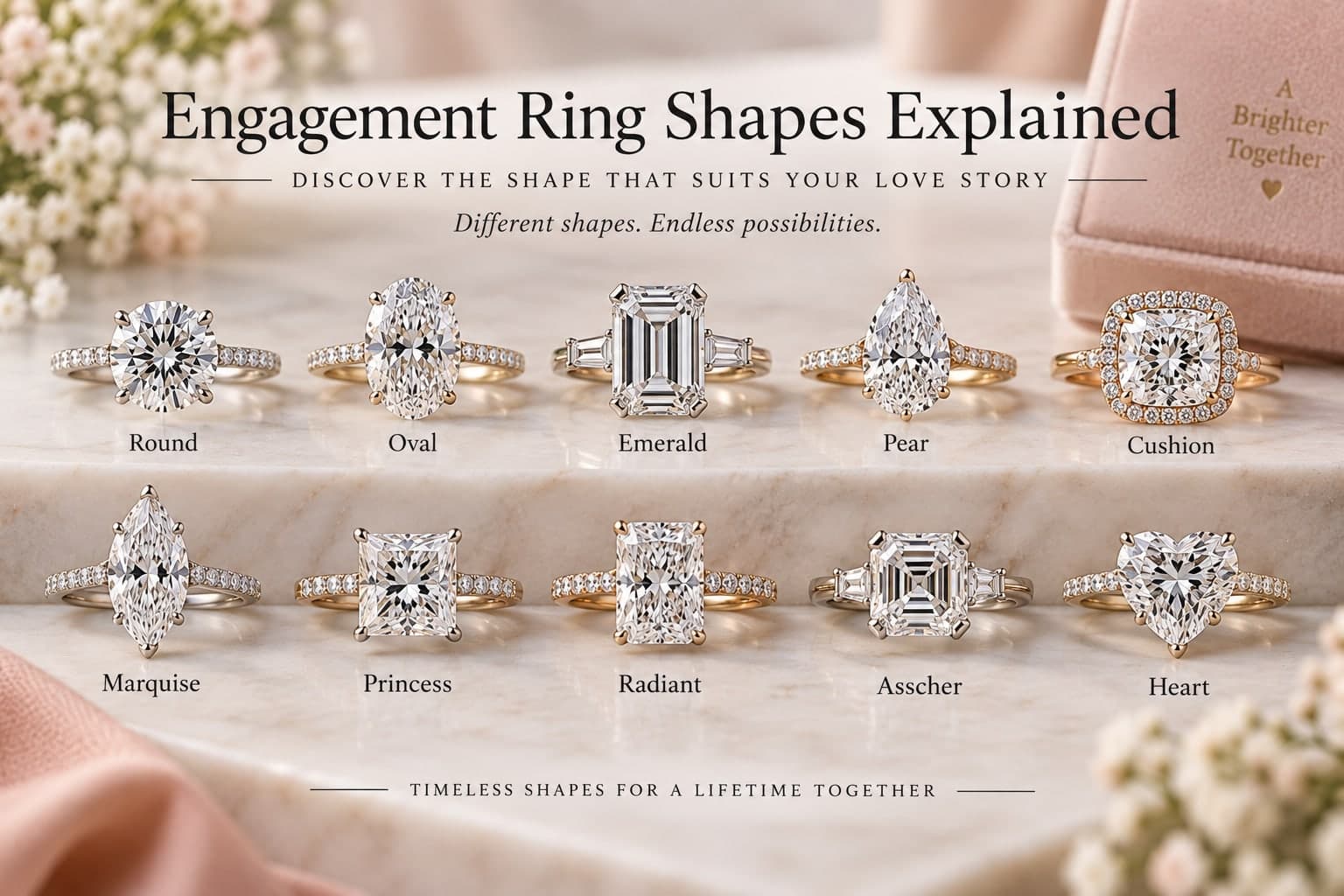
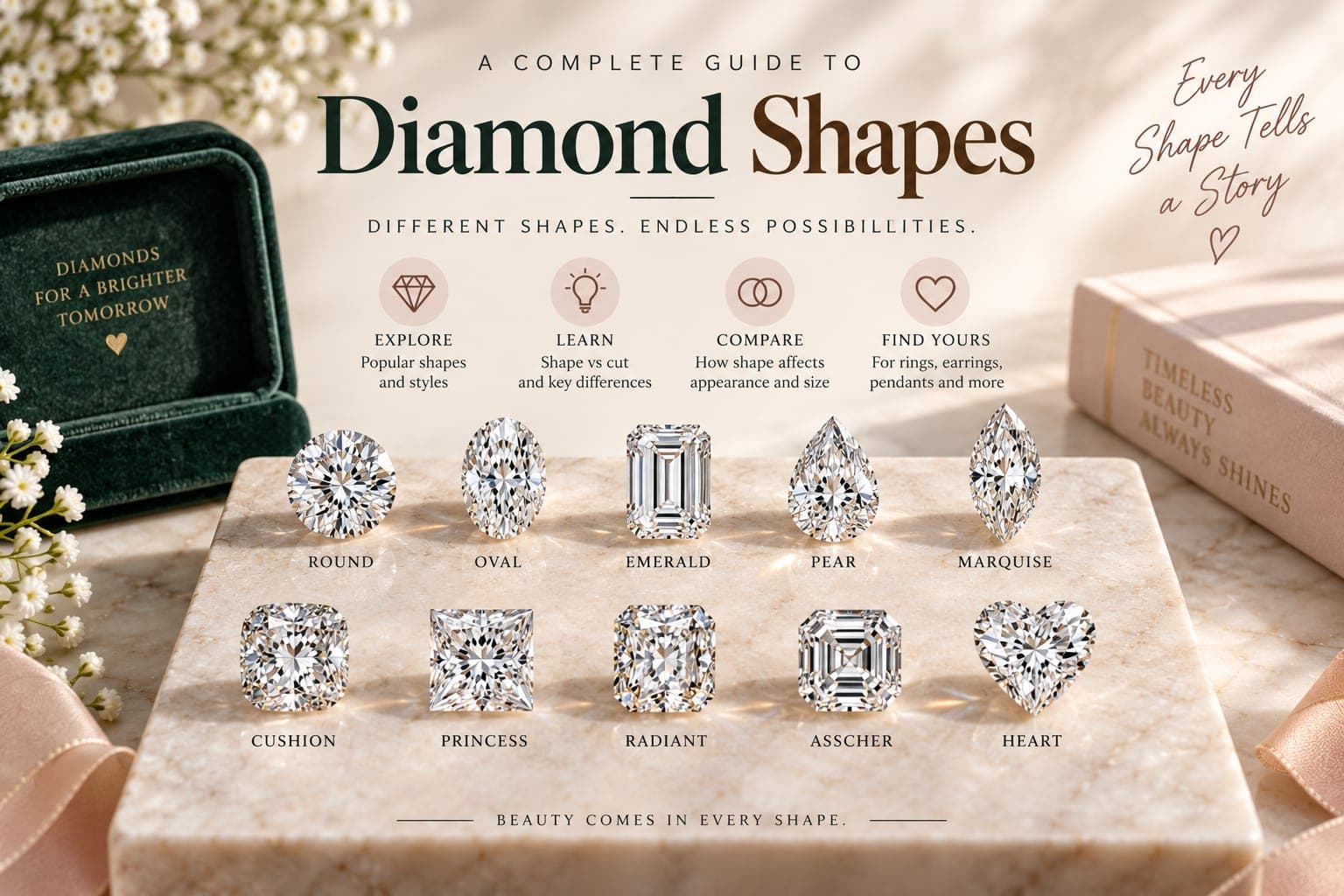
Common examples include:
Round
Oval
Emerald
Pear
Marquise
Cushion
Princess
Radiant
Asscher
Heart
GIA defines diamond shape as the stone's outline or silhouette, while diamond cut refers to the arrangement of its facets.
Shape is therefore one of the first visual characteristics people notice when looking at a diamond.
Diamond Shape vs Diamond Cut
The terms diamond shape and diamond cut are frequently used interchangeably in jewelry shopping, but they technically describe different things.
Diamond shape
Shape describes the outline of the diamond.
For example:
Round → Oval → Pear → Marquise → Heart
Diamond cut
Cut refers to the diamond's proportions, symmetry, polish and facet arrangement.
It influences how the stone interacts with light and contributes to brightness, fire and scintillation.
This is why two diamonds with a similar outline can have different visual characteristics.
Some names, including emerald cut and princess cut, are commonly used to describe both the shape and a particular cutting style.
The Main Types of Diamond Shapes
Let's look at the most widely recognized diamond shapes.
1. Round Diamond
The round diamond is the most traditional diamond shape and one of the most recognizable in fine jewelry.
The round brilliant combines a circular outline with a brilliant faceting arrangement designed to return light effectively.
GIA identifies the round brilliant as the most popular diamond shape and the only standard diamond shape that receives an official GIA cut grade.
Round diamonds are extremely versatile.
They can be used in:
Engagement rings
Wedding bands
Earrings
Pendants
Tennis jewelry
Fashion jewelry
Why choose a round diamond?
A round diamond can work with almost any jewelry aesthetic, from minimalist to elaborate.
Its circular outline also makes it easy to pair with many different settings.
2. Oval Diamond
An oval diamond has an elongated rounded outline.
It combines the curved appearance of a round diamond with a longer silhouette.
Because of its proportions, an oval can appear relatively large from above compared with a round diamond of the same carat weight, although actual appearance depends on the individual stone's dimensions and proportions.
One characteristic to examine when shopping for oval diamonds is the bow-tie effect.
This refers to a darker area that can appear across the center of an oval diamond.
The intensity varies from stone to stone, so looking at the actual diamond is important.
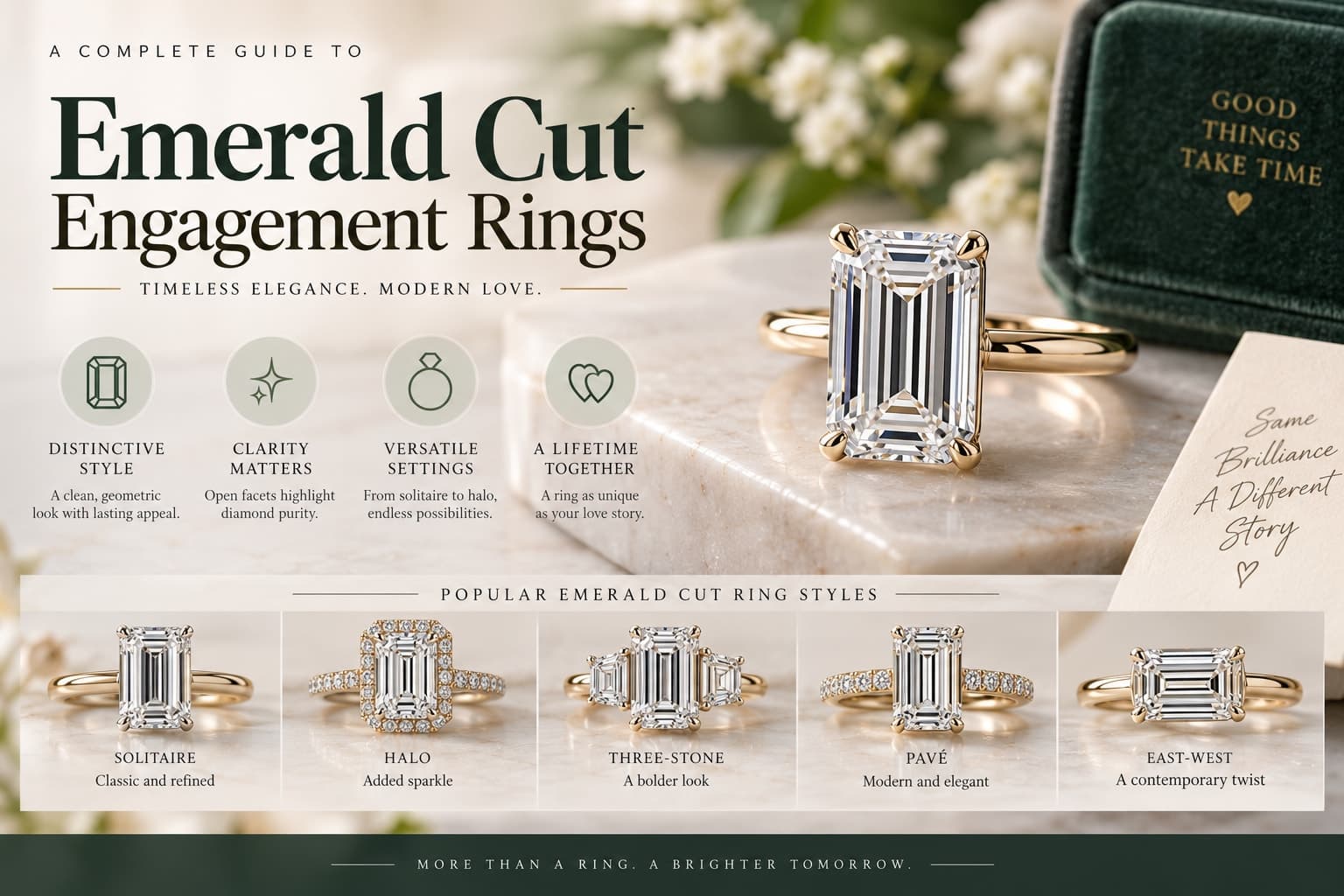
3. Emerald Diamond
The emerald shape is generally rectangular with cropped corners.
Unlike a round brilliant, it uses a step-cut faceting pattern.
The long, open facets create broad reflections and the distinctive "hall-of-mirrors" appearance associated with emerald-cut diamonds.
Because the facets are larger and more open, color and inclusions can be easier to notice.
Emerald diamonds are therefore worth examining carefully rather than judging only by carat weight.
They are particularly popular in:
Engagement rings
Earrings
Pendants
Art Deco-inspired jewelry
4. Pear-Shaped Diamond
The pear shape combines a rounded end with a pointed tip.
Its outline resembles a teardrop.
GIA notes that pear-shaped diamonds combine characteristics associated with round brilliant and marquise-style shapes.
The pointed tip deserves special attention when selecting jewelry because it can be more exposed than the rounded portion.
A secure setting can help protect the point.
Pear diamonds can be particularly distinctive in:
Engagement rings
Drop earrings
Pendants
Statement jewelry
5. Marquise Diamond
A marquise diamond is elongated with pointed ends on both sides.
Its narrow, extended outline makes it visually distinctive and can create a larger-looking face-up appearance for its carat weight.
Because both ends are pointed, the setting should provide appropriate protection.
Marquise diamonds are used in both traditional and contemporary jewelry and can be especially interesting when positioned horizontally.
6. Cushion Diamond
A cushion diamond generally has a square or rectangular outline with rounded corners.
The softer corners give it a different character from sharper square shapes such as princess diamonds.
Cushion diamonds can use different faceting patterns, including brilliant and modified-brilliant variations, so individual stones can look quite different. GIA notes that cushion cuts can range from softer sparkle to more intricate "crushed ice" appearances depending on the faceting style.
Cushion shapes work well in:
Engagement rings
Vintage-inspired jewelry
Earrings
Pendants
Statement rings
7. Princess Diamond
The princess shape is generally square or rectangular with pointed corners.
It has a geometric appearance and commonly uses brilliant-style faceting.
Because its corners are exposed, protective setting techniques are particularly important.
Princess diamonds can create a crisp, structured appearance and are commonly used in rings and other jewelry.
8. Radiant Diamond
A radiant diamond combines a rectangular or square outline with brilliant-style faceting.
Its corners are cropped, giving it a geometric silhouette while reducing the exposure associated with sharp corners.
GIA describes radiant diamonds as combining geometric lines with brilliant-style faceting.
Radiant diamonds can be:
Square
Slightly rectangular
Strongly elongated
This makes proportions particularly important when comparing stones.
9. Asscher Diamond
The Asscher shape has a square outline with cropped corners and step-cut facets.
It shares some characteristics with the emerald cut because both use step-cut faceting.
The major visual distinction is generally the outline:
Emerald → usually rectangular
Asscher → generally square
The large step facets create a reflective, geometric appearance.
As with emerald cuts, color and clarity can be more noticeable because of the open facet structure.
10. Heart-Shaped Diamond
The heart shape is a symmetrical diamond outline with two rounded upper sections and a pointed bottom.
Because the outline itself resembles a heart, it has a strong romantic association.
Symmetry is particularly important with heart-shaped diamonds.
The two sides should create a balanced outline, and the cleft at the top should be clearly defined.
Heart-shaped diamonds can be used in:
Engagement rings
Pendants
Earrings
Romantic statement jewelry
Diamond Shapes Chart
Diamond ShapeGeneral AppearanceKey CharacteristicRoundCircularStrong brilliance and versatilityOvalElongated and roundedGraceful outlineEmeraldRectangularStep-cut reflectionsPearTeardropRounded end and pointed tipMarquiseLong and pointedElongated silhouetteCushionSoft square/rectangleRounded cornersPrincessSquare/rectangularGeometric appearanceRadiantSquare/rectangularBrilliant-style facetingAsscherSquareStep-cut geometryHeartHeart-shapedSymmetrical romantic outline
Brilliant Cut vs Step Cut
Understanding cutting styles helps explain why different diamond shapes look so different.
Brilliant Cut
Brilliant-style faceting uses numerous facets arranged to reflect light and create brightness, fire and scintillation.
Round brilliant is the most recognizable example, but brilliant-style faceting can also be used on shapes such as oval, pear, marquise, princess and radiant.
Common examples
Round
Oval
Pear
Marquise
Princess
Radiant
Some cushion diamonds
Step Cut
Step cuts use larger, elongated facets arranged in a pattern that creates a reflective appearance.
The best-known examples are:
Emerald
Asscher
Step cuts tend to reveal color and clarity characteristics more readily because of their larger, open facets.
How Diamond Shape Affects Appearance
Shape isn't only about aesthetics.
It can influence how the diamond looks in jewelry.
Face-Up Size
Some elongated shapes can appear larger from above compared with round diamonds of the same carat weight.
Oval, marquise and pear diamonds are examples.
However, carat weight alone cannot tell you how large a diamond will look.
Measurements and proportions matter too. Tiffany specifically notes that diamonds with the same carat weight can appear different in size depending on their shape and depth.
Sparkle
The shape itself doesn't tell you exactly how much a diamond will sparkle.
The faceting style, proportions, symmetry and polish all matter.
Brilliant cuts are designed around strong light return, while step cuts create broader reflections.
That's why a round brilliant and an emerald diamond can have completely different visual personalities.
Color Visibility
Some shapes show color more readily than others.
Brilliant-style faceting can help disguise some color characteristics, while step-cut diamonds such as emerald and Asscher may make body color easier to notice.
This is one reason color deserves extra attention when comparing step-cut diamonds.
Clarity Visibility
The same principle applies to clarity.
The numerous facets of a brilliant-cut diamond can help disguise some inclusions.
The larger open facets of a step-cut diamond can make inclusions easier to see.
So the same clarity grade doesn't necessarily look identical across every shape.
Diamond Shape and Jewelry Type
You don't have to choose a diamond shape specifically for an engagement ring.
Different shapes work across many categories of jewelry.
Engagement Rings
Round, oval, emerald, pear, cushion, marquise, princess and radiant are all common choices.
Earrings
Round diamonds are particularly versatile, while pear, oval and emerald shapes can create distinctive drop or stud designs.
Pendants
Pear, heart, oval and emerald shapes can work well for pendants because their outlines remain visible when worn.
Bracelets
Smaller round, oval and other shapes can be used as accent stones or repeated patterns.
Fashion Jewelry
Unusual shapes such as heart, marquise or geometric diamonds can become focal points in statement designs.
This broader jewelry context is why this Diamond Shapes Guide is different from your existing Engagement Ring Shapes Explained article.
How to Choose a Diamond Shape
There is no single shape that works for everyone.
Instead, consider several characteristics.
1. Think About the Overall Look
Do you prefer:
Traditional?
Modern?
Geometric?
Soft and rounded?
Vintage-inspired?
Unusual?
Your preferred aesthetic can narrow the options.
2. Consider the Jewelry
The same shape may look different depending on the jewelry design.
A pear-shaped diamond in a pendant has a different visual effect from a pear-shaped diamond in an engagement ring.
Think about the complete piece rather than the stone alone.
3. Look at Proportions
For fancy shapes, proportions matter.
GIA recommends considering factors such as length-to-width ratio, symmetry, smooth curves and whether the intended shape is clearly defined.
For example, an oval that is extremely narrow may have a very different appearance from a wider oval.
4. Check Symmetry
Symmetry is particularly important for shapes such as:
Heart
Pear
Oval
Marquise
An uneven outline can become obvious when viewed face-up.
5. Examine the Actual Diamond
A grading report provides valuable information, but photographs and videos can also help you understand how an individual diamond looks.
GIA recommends viewing diamonds in different lighting conditions because lighting can affect their apparent brightness and sparkle.
If you're buying online, look for high-quality images and videos when available.
Diamond Shape and Carat Weight
Carat weight is a measurement of weight, not simply visual size.
One carat equals 0.2 grams.
Two diamonds with identical carat weights can have different visible dimensions because their shapes and proportions differ.
For example, an elongated oval may have a very different face-up outline from a round diamond of the same weight.
This is why comparing only the carat number can be misleading.
Look at:
Carat weight
Length
Width
Depth
Length-to-width ratio
Overall proportions
Which Diamond Shape Looks the Biggest?
There isn't a single answer because perceived size depends on proportions, depth and how much of the stone's surface is visible from above.
Elongated shapes such as oval, marquise and pear can create the impression of a larger face-up diamond compared with a round diamond of the same carat weight.
However, a poorly proportioned diamond isn't automatically a better value simply because it has a large surface area.
Evaluate the complete stone.
Which Diamond Shapes Have the Most Sparkle?
Sparkle depends heavily on cut quality and faceting, not simply the outline.
The round brilliant is particularly well known for its brilliance, and brilliant-style faceting is also used on several fancy shapes. Tiffany notes that round brilliant diamonds are designed for strong brilliance, while oval, marquise, pear and heart diamonds can also use brilliant faceting.
Step-cut diamonds such as emerald and Asscher create a different effect, emphasizing broad reflections rather than the same type of scintillation.
Which Diamond Shape Is Best for You?
Rather than asking which shape is universally "best," compare the characteristics that matter to you.
If you like classic designs
Consider round.
If you prefer an elongated outline
Consider oval, pear or marquise.
If you like geometric designs
Consider emerald, Asscher or princess.
If you prefer softer corners
Consider cushion.
If you want brilliant sparkle with a rectangular outline
Consider radiant.
If you want a romantic outline
Consider heart.
These are simply starting points. The setting, metal, proportions and individual diamond can completely change the finished appearance.
Diamond Shapes and Settings
Shape and setting should be considered together.
Pointed shapes such as pear, marquise and heart require particular attention around their tips.
GIA notes that certain shapes may need specific setting approaches to emphasize their outline or protect vulnerable points.
For example:
Pear → protect the point
Marquise → protect both tips
Heart → preserve the shape and cleft
Princess → protect the corners
Emerald → emphasize the geometric outline
If you're specifically researching engagement ring construction, see our separate Engagement Ring Settings Explained guide.
Diamond Shapes and the 4Cs
Shape is only one part of evaluating a diamond.
You should also consider the 4Cs:
Cut
Affects how the diamond interacts with light.
Color
Describes the degree of color visible in the diamond.
Clarity
Describes internal inclusions and surface blemishes.
Carat
Measures diamond weight.
GIA recommends considering these characteristics together rather than evaluating a diamond based on one specification alone.
Diamond Shape Buying Checklist
Before buying a diamond, consider:
☐ Choose the preferred shape
☐ Understand shape vs cut
☐ Check the diamond's measurements
☐ Compare proportions
☐ Check symmetry
☐ Consider color
☐ Consider clarity
☐ Review carat weight
☐ Examine the actual stone where possible
☐ Look at different lighting conditions
☐ Consider the intended jewelry setting
☐ Review the grading report
Frequently Asked Questions
What are the main diamond shapes?
The major diamond shapes include round, oval, emerald, pear, marquise, cushion, princess, radiant, Asscher and heart. Tiffany and GIA both use these or closely related categories in their current diamond education materials.
What is the most popular diamond shape?
Round is the most traditional and widely used diamond shape. GIA identifies the round brilliant as the most popular diamond shape.
What is the difference between diamond shape and diamond cut?
Shape describes the diamond's outline, while cut refers to facet arrangement, proportions, symmetry and polish and how these characteristics affect the diamond's interaction with light.
Which diamond shape looks the largest?
Elongated shapes such as oval, marquise and pear can create a larger face-up appearance relative to a round diamond of the same carat weight, although actual appearance depends on proportions and measurements.
Which diamond shapes are considered fancy shapes?
In common industry terminology, diamonds other than round brilliant are generally called fancy shapes. Examples include oval, pear, marquise, cushion, emerald, princess, radiant and heart.
Are emerald and Asscher diamonds the same?
No. Both commonly use step-cut faceting, but emerald diamonds are generally rectangular while Asscher diamonds are generally square with cropped corners.
Does diamond shape affect price?
Shape can influence pricing, but it isn't the only factor. Carat weight, cut characteristics, color, clarity, proportions and market demand all contribute to a diamond's price.
Final Thoughts
Diamond shapes give jewelry its basic visual outline, from the timeless circle of a round diamond to the elongated profile of a marquise, the geometric lines of an emerald, or the romantic silhouette of a heart.
But shape is only one part of the equation.
The diamond's cut, proportions, symmetry, color, clarity and carat weight all influence its appearance and value.
The best way to compare diamonds is to look beyond the name of the shape and examine the individual stone.
Once you understand that difference, terms such as round, oval, emerald, pear, cushion, marquise, princess, radiant, Asscher and heart become much easier to understand—and choosing a diamond becomes a much more informed process.